

Camouflage literally means “masking” in French. But in the context of military affairs, it is a spotted or pixelated camouflage pattern that makes a person or object invisible in natural surroundings, as if “blurring” the silhouette and making it difficult to recognize contours.
If we look back at history, one of the first types of camouflage was khaki (translated from Persian as “the color of dust”), although the concept of visual deception has been around since time immemorial. With the passage of time and new armed conflicts, this issue became increasingly relevant. For example, during the Anglo-Boer War (1899-1902), the British suffered heavy losses largely due to the traditional red color of their uniforms, so it was decided to replace it with a color more suitable for use in the field, and it worked. As military equipment evolved, camouflage colors changed to adapt to different types of terrain. The real challenge was to create a universal pattern that would provide camouflage in different conditions.
A brief history of the evolution of the modern Ukrainian uniform
Until 2014, the Ukrainian military used a uniform inherited from the Soviet army, which was outdated, uncomfortable, and went down in history under the name “Bhutan”. Based on this camouflage, the famous Ukrainian “Dubok” was created in 1996, which differed from its predecessor in color nuances and a slightly different fabric composition. It quickly faded in the sun and, due to its high content of natural fibers, burned even faster when exposed to high temperatures. With the start of Russian aggression in 2014, the military was offered a new option – the so-called “Geleteika,” named after former Defense Minister Valery Geletey, under whom the uniform was introduced. The fabric consisted of more than 80% synthetic materials and 15-20% cotton, stuck to the body, and worse, when exposed to fire, it melted and significantly increased the area of burns, exacerbating losses that could have been avoided. So the “Geleteika” failed the test. Soldiers on the front lines preferred to wear any used uniforms brought by volunteers from abroad rather than those issued to them.
In 2015, a list of items for the combat uniform set for military personnel was approved, which included 65 items of military clothing, equipment, and personal protective equipment, as well as the new Ukrainian MM-14 camouflage. At the same time, Ukrainian equipment manufacturers began to work on their own patterns for military uniforms, and some of the domestic designs became so successful that they were adopted as the main camouflage by certain units and law enforcement agencies. Today, the soldiers of the Defense Forces use a variety of camouflage patterns, both Ukrainian and foreign-made.
Features of fabric for military needs
Let’s note right away that fans of natural fabrics are in for a disappointment: cotton, wool, and linen make up only a small percentage of the materials used in uniforms and equipment. And this is quite understandable: it is synthetic fibers that make the fabric stronger and more resistant to wear and tear and other operational risks. This industry is also constantly evolving, with various combinations/weaves of fibers being tested and acquiring additional characteristics, including water-repellent properties, thermoregulation, fire resistance, and more.
It is worth mentioning the most famous material in military circles – Cordura 500D and 1000D, which has no analogues and is still unmatched in terms of characteristics as a fabric for bulletproof vests and other elements of military equipment. The material has only one significant drawback – it is quite expensive.
And, of course, all materials can be camouflaged – whether it’s Ukrainian pixel or American MultiCam.
Camouflage groups, or How the environment influences the choice of camouflage pattern

Let’s note right away that fans of natural fabrics are in for a disappointment: cotton, wool, and linen make up only a small percentage of the materials used in uniforms and equipment. And this is quite understandable: it is synthetic fibers that make the fabric stronger and more resistant to wear and tear and other operational risks. This industry is also constantly evolving, with various combinations/weaves of fibers being tested and acquiring additional characteristics, including water-repellent properties, thermoregulation, fire resistance, and more.
It is worth mentioning the most famous material in military circles – Cordura 500D and 1000D, which has no analogues and is still unmatched in terms of characteristics as a fabric for bulletproof vests and other elements of military equipment. The material has only one significant drawback – it is quite expensive.
And, of course, all materials can be camouflaged – whether it’s Ukrainian pixel or American MultiCam.
Camouflage groups, or How the environment influences the choice of camouflage pattern

All types of camouflage are divided into several types of masking (depending on the terrain):
- “forest” – mainly Europe, America
- “desert” – North Africa, Central Asia
- “jungle” (tropics) – Asia, South America
- “winter” – for winter warfare
- “bush” – Southern Africa
The world’s most famous camouflage patterns
MM-14
Yes, we will start with Ukrainian camouflage, because how else could we not – it is ours, and it is also one of the ten most famous. MM-14 (acronym for “Camouflage Pattern 2014”), Pixel, or Ukrainian pixel camouflage is a digital deformation camouflage with a 5-color pattern that appeared in the Armed Forces of Ukraine in 2014, replacing the outdated “Dubok,” although the first mentions of it appeared several years earlier. The history of testing and refinement of MM-14 is quite turbulent – since 2012, various color schemes and fabrics have been tested in the brigades of the Armed Forces of Ukraine, until its modern appearance crystallized – a light beige background with pixelated spots of dark marsh green, gray-green, dark gray, and light green shades, which visually blur the silhouette and make the soldier invisible. Although there is a visual similarity to some American camouflage patterns, the MM-14 color scheme is unique – ideal for the natural conditions of Ukraine. Pixel has a second version – blue, for the Navy. It is mainly twill fabric, with a combination of cotton and synthetic fibers.
MultiCam

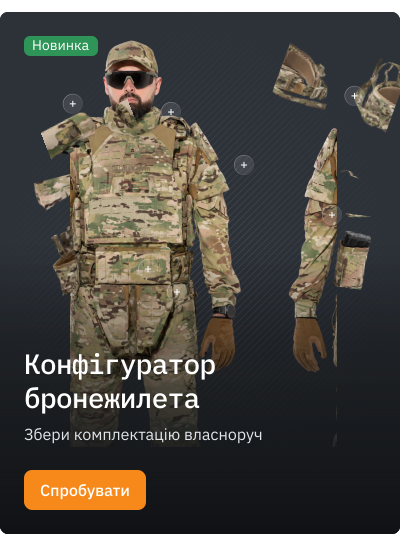
Undoubtedly, the world’s most popular camouflage was created in 2002 for one of the US Army’s experimental projects, “Future Force Warrior,” and was positioned as universal – suitable for any terrain. MultiCam consists of irregular spots of seven colors. Even two unsuccessful attempts to become the official camouflage of the US Army did not hinder its popularity. MultiCam achieved great popularity in the civilian market, was used in movies and comics, appeared in the American science fiction action series Transformers, and in 2007 became part of pop culture. All over the world, units massively switched to MultiCam. It is officially used in Ukraine by the special unit of the Special Operations Center of the Security Service of Ukraine “A” and in the US by some secret services. Versions of MultiCam have been officially adopted by a number of countries around the world. From a simple addition to a futuristic project, it has become a giant in the world of camouflage, and it is unlikely that anyone will be able to displace it.
It is also successfully used by Ukrainian developers of military equipment, and our brand also uses it for the pouches and the new modular bulletproof vest “Multik”.
Woodland
Woodland camouflage has been used by the US Army since 1981 and was originally designed for jungle operations, but then developers applied the principle of color variability to it, and Woodland became universal. The pattern uses four colors: two shades of green (light and dark), black, and brown. This color combination ensures high adaptability. Woodland is supplied to many countries, and in the US today it is used by some law enforcement agencies.
Flecktarn

German camouflage began to be used by the military in 1989. The developers managed to achieve an optimal balance between deformative and imitative motifs in a five-color pattern, combining small spots into large groups. The authors also drew on the experience of World War II – some elements are associated with German camouflage of that period. Flecktarn was developed for camouflage in temperate climates and mixed forests. It is still part of the uniform in Germany and is also used by the Belgian and Austrian armies as their primary camouflage.
MTP

Camouflage has been used by the British Army since 2010, replacing DPM. The color scheme uses motifs from DPM and American MultiCam. MTP, as a fabric for body armor and uniforms, is designed for camouflage in various types of terrain and comes in seven colors. It was first used by British troops in Afghanistan, where the landscape is mixed – desert, forest, mountains, and urban structures. The camouflage is very popular and is used by many special services in different countries.
Kryptek

The Kryptek company, founded by American veterans, introduced universal camouflage for hunters and the military in 2011. The masking properties of this color scheme consist in imitating a three-dimensional image, for which the main background is shadows superimposed without sharp transitions. Clear geometric shapes contrast with the pattern of the main background. Up close, the image resembles snake scales. There are six main colors: Mandrake, Urban, Highlander, Nomad, Typhon, and Yeti.
Marpat

Since 2002, this has been the official camouflage of the US Marine Corps, and only marines have the exclusive right to use this camouflage, which is prohibited in other units. Marpat (Marine pattern) combines olive, several shades of green, brown, and black and belongs to the advanced digital color scheme. This type of pattern is considered the most effective: it has no obvious seams or contrasting colors, the pattern is broken into rectangular parts and seems to break the symmetry of the human silhouette, which is good for observation from 50 or even 300 meters. This versatile camouflage has two variants – for forest and desert.
A-TACS
Camouflage, whose name stands for Advanced Tactical Concealment System, was developed by the American company DCS in 2010 and immediately attracted the interest of law enforcement agencies. The developers abandoned traditional approaches and used blurred spots of natural colors resembling vegetation in the pattern. There are four main colors of this camouflage: for forests, deserts, urban environments, and a universal one with an adaptive pattern.
DPM

British camouflage with a pattern of elements that appear to be torn apart. The developers sought to achieve precisely this effect – to visually tear apart the object, destroy it, and “blur” its contours. DPM (Disruptive Pattern Material) was created in the 1960s for the British Army. The pattern has four main colors – black, brown, green, and sand. There are two variations – for forests and deserts. Surprisingly, outside of Britain, there is a demand for the desert type of DPM.
Acupat
This is also US Army camouflage, which replaced Woodland because the latter caused dissatisfaction among the military during combat operations in the Middle East. Development began in 2004, with the main requirement being successful camouflage in different terrains. Experts created a pattern that is difficult to see with night vision devices, but used unnatural light gray colors. Without black to imitate shadows, camouflage did not work in the forest. However, Acupat was still used for a long time by the US military, for example, in the Iraqi and Afghan campaigns.
Camouflage for the military is an effective way to conceal personnel, equipment, positions, and mislead the enemy about intentions and locations. The importance of a high-quality camouflage pattern cannot be overestimated. Therefore, the study, development, and testing of new materials, colors, and color combinations in the context of their camouflage properties continues. For example, the media periodically reports on tests of camouflage that works on the principle of a chameleon, i.e., it changes color according to the background against which it needs to be concealed.

