

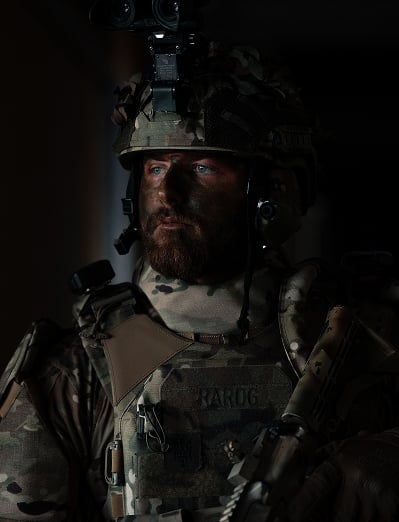


Conscious and consistent training of soldiers for combat operations is the key not only to their effectiveness on the battlefield and successful completion of combat missions, but also to preserving their health and lives. Military training consists of many processes, such as physical training, moral and volitional qualities, improving fire skills, tactics and medicine, as well as the selection of high-quality tactical equipment. A lot has already been said about the components of protection – body armor/plate carriers, plates, ballistic packs – but it is also important to have a convenient and compact system for storing and transporting personal protective equipment, necessary tools, first aid kits, water, provisions, etc. So, let’s talk about the essential elements of equipment – pouches and their placement on personal protective equipment.
Features of placing pouches on a bulletproof vest
Let’s start with the fact that there are three basic principles for placing pouches on a bulletproof vest.
- Easy access. Pouches should be placed so that essential items can be accessed without unnecessary effort, instantly, and ideally with one hand.
- Balance. The placement of pouches should be even – with approximately equal weight on the right and left sides, otherwise problems with coordination of movements may arise.
- Clear organization. It is not enough to attach a pouch to a bulletproof vest; you need to use the space to its fullest: dividing it into compartments, internal and secret pockets will allow you to organize the contents conveniently and logically.
Now, there is the most important part.
There is no universal formula or exact scheme for placement – the location of pouches and their contents are purely individual and depend on the conditions in which the soldier performs his tasks, his needs, and even his character.

At the same time, it should be noted that many units apply the principle of standardizing the placement of pouches, especially first aid kits, so that in combat conditions, comrades-in-arms can quickly provide first aid to the wounded using items from their first aid kit without wasting time searching for it in their equipment.
Everything we will discuss below will be advisory in nature; these are tips from experienced military personnel that a soldier can listen to.
When preparing for a combat mission, it is important to consider its specifics and other factors, such as how long the mission will last, the expected intensity of combat, the type of weapon the soldier will be using, how much ammunition and provisions are needed, etc. If the mission is reconnaissance, the load should be minimal, because it is important to be mobile and move easily and quickly. During assault operations, for example, it is necessary to have more magazines on hand to quickly reload weapons.
Although it is said that each piece of equipment should be freely accessible, there are several items whose contents are really important to be able to reach in a few seconds with a light movement – the so-called first echelon items. These include: personal weapons, BC, grenades, communication devices, orientation devices, tourniquet, individual first aid kit, flashlight, knife, multitool. All of these items are essential and are always used, regardless of the type of combat mission.
- In combat conditions, it is important not to be left “empty,” so the magazine pouch should be placed so that the magazine can be accessed with one movement and the weapon can be quickly reloaded. If you are right-handed, then the weapon is in your right hand, and the magazine pouches are on the left. The pouch for discarding magazines is usually attached in the same place. Magazines are placed with the feeder facing down to minimize dirt ingress.
- It is equally important to save the soldier’s life. Therefore, the first aid kit pouch is placed so that it does not interfere with movement and, ideally, can be easily reached with both hands. The Rarog range includes medical pouches designed according to military recommendations. We recommend pouches on a tear-off platform, from which the first aid kit can be removed in seconds. Another option is the ROLL side-mounted first aid kit, which is attached to a Velcro platform at the front instead of the chest plate or at the back, below the end of the armor plate. It is generally recommended to have at least one tourniquet in the first aid kit and at least one more outside in an area of immediate access. Many of our brand’s pouches have a place for attaching a tourniquet, as its quick availability literally saves lives.
- An administrative pouch with documents and orientation tools, such as a map, compass, or tablet, is usually placed on the chest.
- Communication devices should also be quickly accessible, either on the shoulder or chest.
- Special tools – a knife and/or multitool – are most conveniently attached to the front or side, which makes them easy to access when needed.
When assembling pouches before each task, all items should be carefully checked for integrity and functionality.

Common mistakes when placing pouches on body armor
The most critical mistakes are related to non-compliance with the basic principles of placing pouches on body armor.
- Imbalance. The load is unevenly distributed, the pouches are poorly secured – this hinders movement, complicates the use of equipment, and reduces the soldier’s effectiveness.
- Overloading. When equipping yourself with pouches and selecting armor plates, you should take your physical condition into account – heavy weight is exhausting, and what seemed light at first can become an unbearable burden in a few hours and cause serious health problems. In addition to limiting mobility, too many items interfere with aiming and access to the most important items.
- Inappropriateness. If you do not carefully select pouches for each situation, you can become a burden to the combat group and endanger yourself and your comrades.
- Lack of preparation. For a good bulletproof vest and high-quality pouches to be comfortable and useful, the soldier must feel comfortable with them. This means that before using them in combat conditions, you should train in full gear.
An important nuance to keep in mind during training is the principle of “don’t look, feel”: it is necessary not only to know where everything is located, but also to be able to work with the equipment even in stressful situations or in conditions of poor visibility. For this reason, experienced soldiers often advise training so that you automatically “feel” the pouches and items on your body armor without looking at them.

Examples of attaching pouches to body armor
There are several ways to attach a pouch to body armor, but the most common are MOLLE and Velcro.
- Molle (from Modular Lightweight Load-carrying Equipment) is a unique way to connect equipment into a single system, which consists of attaching accessories to slings (in our case, pouches) on the loops of the main item – a bulletproof vest, backpack, etc. Molle was first used by the US military in the early 2000s. It helped soldiers quickly and efficiently assemble equipment according to the task at hand. This system allows you to easily configure the desired configuration and change equipment elements as needed, while proving itself to be durable and reliable.
- Velcro is a two-layer fastener consisting of hook and loop material. In military equipment, Velcro is used both as a fastener and as a platform for attaching identification marks. The Velcro system is very convenient for items that are frequently removed and attached, and pouches are just such items.
So, let’s draw some conclusions. Take the time to adjust all elements so that the pouches on the body armor are compact and meet the needs of a specific combat situation. Check the comfort of the body armor with pouches during physical activity. And remember that even the best equipment will not be effective if the soldier does not train with it before going into combat.
